How to Brew V60 Coffee and Make Pour-Over at Home

Learning how to brew V60 coffee is one of the most common starting points in specialty coffee. The method is popular for both its simplicity and the clarity it produces in the cup. However, the ratio, grind size, and pouring technique all determine whether the result tastes flat or properly showcases the coffee’s origin.
This guide explains how to brew V60 coffee step by step, including the equipment you need, the right coffee-to-water ratio, and the precise techniques required to make pour-over coffee at home, even without previous experience.
Equipment Needed to Brew V60 Coffee
- A V60 dripper made from ceramic, glass, or plastic
- Filters that match the size of your V60
- A kettle, ideally with a gooseneck spout for better pouring control
- A scale to measure the coffee and water accurately
- A coffee grinder so you can grind immediately before brewing
- A timer to track the total brewing time
A gooseneck kettle is not mandatory, but it makes a slow and consistent pour much easier, which is essential for an even extraction.
The Right Coffee-to-Water Ratio for V60
The ratio directly controls the strength and balance of the coffee. Most recommendations fall between 1:15 and 1:16, meaning approximately 15 to 16 grams of water for every gram of coffee.
| Number of Cups | Coffee | Water |
|---|---|---|
| 1 cup | 15 g | 240 g |
| 2 cups | 22 g | 350 g |
| 3 cups | 30 g | 480 g |
Use this ratio as a starting point. Reduce the water slightly for a stronger cup, or add more water if you prefer a lighter result.
Steps for Brewing a Balanced V60
-
Rinse the Filter
Place the filter in the dripper and rinse it with hot water before adding the coffee. This removes any papery flavour and preheats the dripper, helping maintain a stable temperature during brewing. Discard the rinse water before continuing.
-
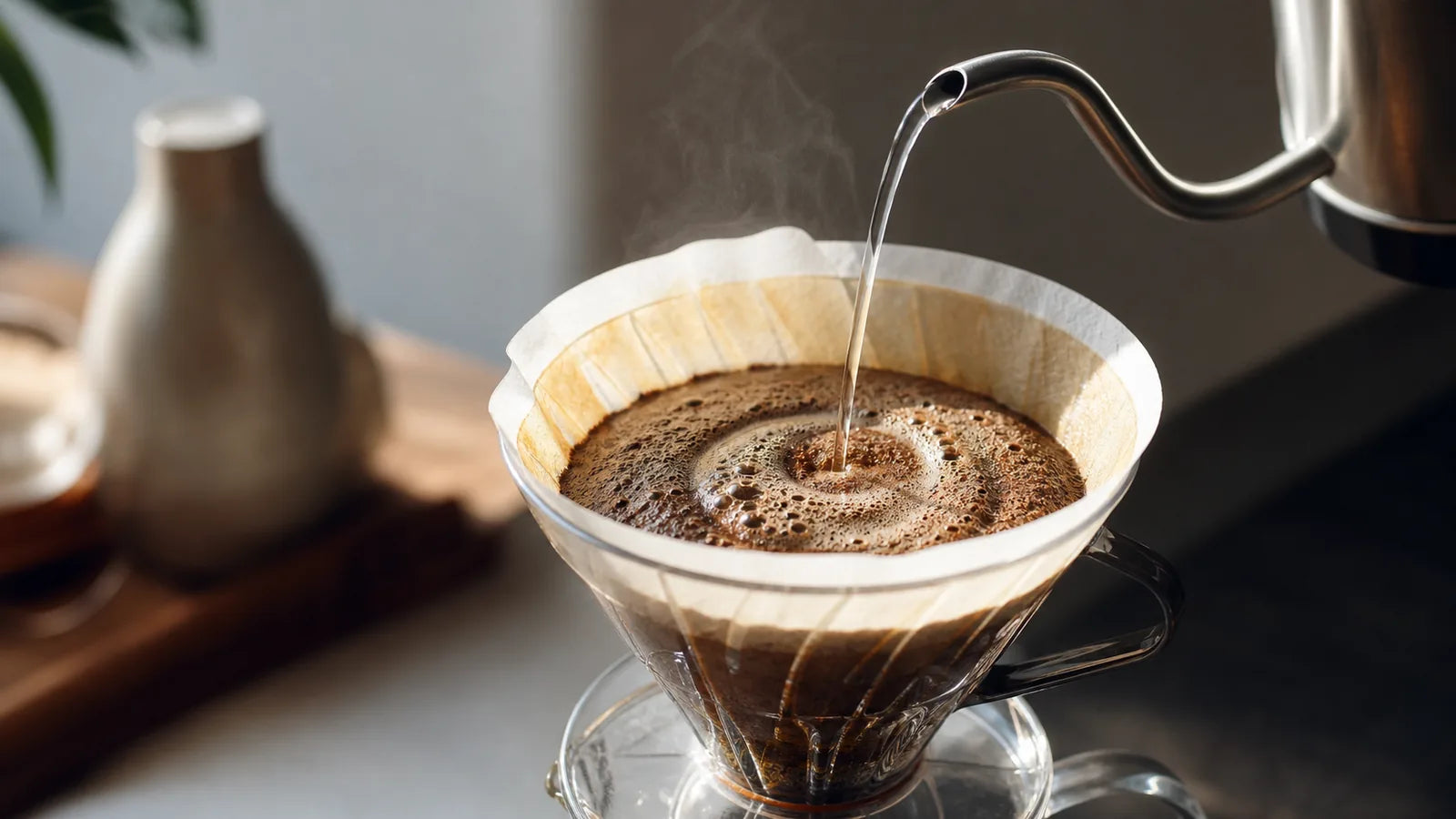
Bloom the Coffee
Add the ground coffee, create a small depression in the centre, and pour approximately twice the coffee’s weight in hot water at around 92 to 96°C. Let it sit for 30 to 45 seconds. This stage, called the bloom, allows trapped carbon dioxide to escape before the main extraction and promotes more even brewing.
-
Complete the Pour
Add the remaining water in several stages using small concentric circles and avoid pouring directly onto the sides of the filter, a technique described in this V60 brewing guide. The complete pour should take approximately two to three minutes, until all the water has passed through the coffee bed.
To select the right beans for your brewing method, read our guide to espresso and filter coffee beans.
Common Mistakes to Avoid
A grind that is too fine slows the water and produces bitter, over-extracted coffee, while a grind that is too coarse creates a weak and sour cup. Pouring too quickly or unevenly can also over-extract some areas and under-extract others within the same coffee bed, reducing balance.
Forgetting to rinse the filter is another frequent beginner mistake. Water that is too close to boiling can also emphasize bitterness instead of revealing the coffee’s aromas.
Why V60 Remains a Reference Brewing Method
V60 is popular because it reveals clarity and aromatic complexity, particularly in light-roast coffees. Unlike immersion methods such as a French press, V60 uses percolation, producing a lighter body but often making individual flavour notes easier to identify.
Its cone shape and spiral ribs, designed by Japanese manufacturer Hario, support controlled water flow. This gives home brewers room to adjust the extraction speed through grind size and pouring rate.
It is also financially accessible. A basic dripper costs a fraction of the price of an espresso machine while producing results that can rival more expensive methods when the technique is properly controlled.
Adjusting the Recipe for the Coffee Profile
A light-roast coffee is often denser and generally benefits from a slightly finer grind and hotter water to extract its flavours properly. A darker roast is more soluble and usually requires a slightly coarser grind to avoid a fast, bitter extraction.
Total brew time is a useful indicator when adjusting the recipe. If the water drains in less than two minutes, try a finer grind. If brewing takes significantly longer than three and a half minutes, use a coarser grind.
Conclusion
Making V60 coffee at home primarily requires precision, a reliable ratio, an appropriate grind, and a consistent pour. Once these fundamentals are in place, it becomes easy to adjust the recipe according to your preferences and the coffee profile.
Explore coffees designed for filter brewing in the Bright Series, and learn more in our guide to keeping coffee fresh.
FAQ
What is the right ratio for V60 coffee?
Most V60 recipes use a coffee-to-water ratio between 1:15 and 1:16, meaning approximately 15 to 16 grams of water for every gram of coffee. For one 240 ml cup, use approximately 15 grams of coffee. Treat this as a starting point and adjust the water slightly according to your preferred strength.
How long should a V60 brew take?
A complete V60 brew generally takes between two and three and a half minutes, including the initial bloom. If the water drains too quickly, the grind is probably too coarse. If brewing takes much longer, the grind may be too fine and can produce bitter, over-extracted coffee.
What grind size should you use for V60?
A medium grind, similar to sand or coarse sugar, generally works well for V60. The exact setting depends on your grinder and the coffee’s roast profile. A light roast can often tolerate a slightly finer grind than a darker roast, helping preserve its natural acidity and delicate aromas.

David Boucher
Author
Founder - CEO
Montreal Coffee Roaster: A Guided Visit to Escape Lab
Montreal Coffee Roaster: A Guided Visit to Escape Lab
Read next article